You've been invited to a case conference

A GP who shares the care of one of your patients would like your input — one short, secure video discussion to bring the patient's care team onto the same page.
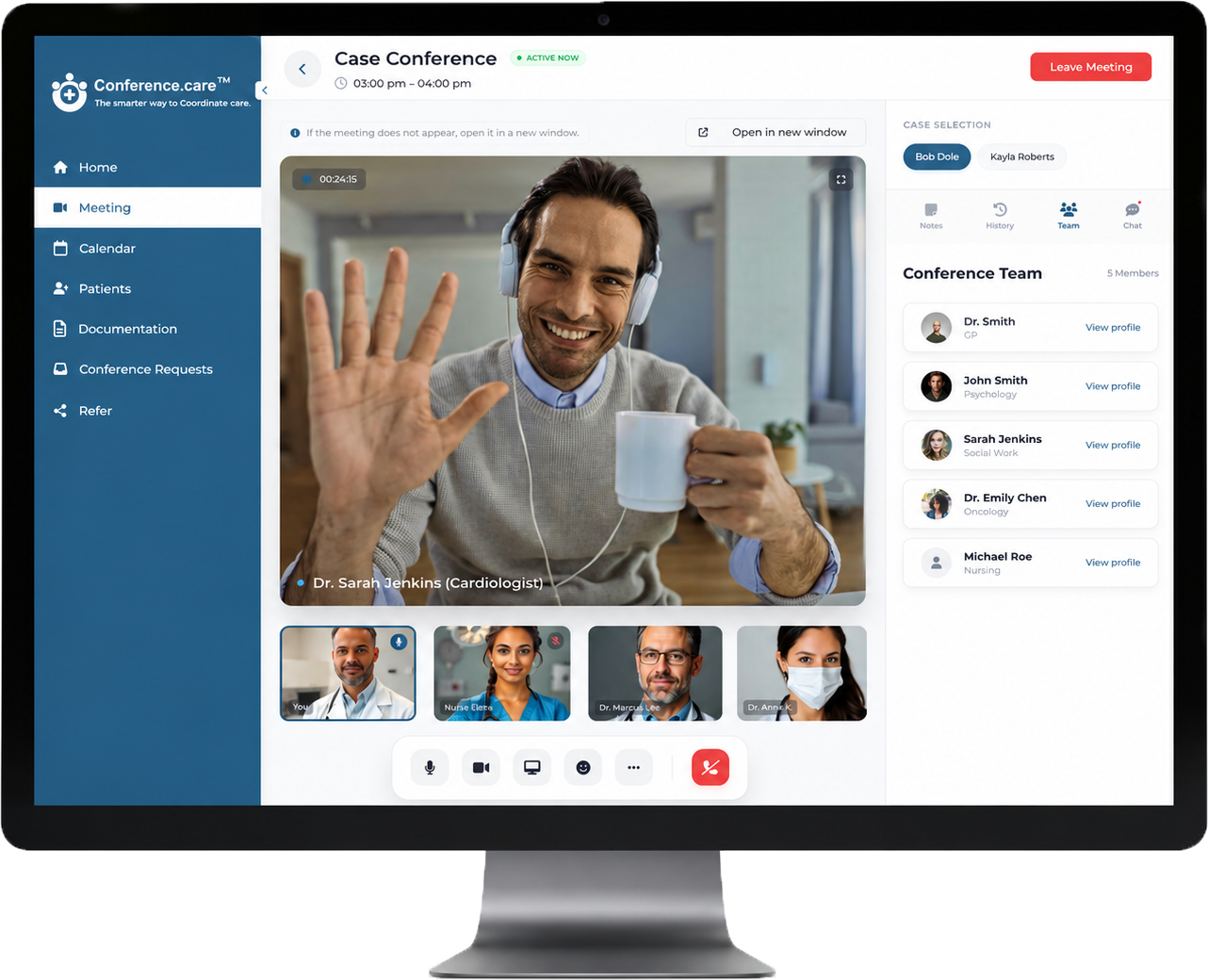
A Conference.care multidisciplinary case conference in progress
Your participation isMBS-billable

What is a case conference?

A case conference is a multidisciplinary meeting between a patient's GP and the other clinicians involved in their care — specialists, consultant physicians, and allied & mental health practitioners — to coordinate care for a patient with complex or chronic conditions.

Unlike letters and referrals, a case conference is real-time dialogue — shared decision-making and a cohesive treatment plan, without requiring the patient to attend or be referred externally.

The goal: ensure every aspect of the patient's health is addressed in a coordinated way — improving continuity of care and reducing duplication, conflicting advice and system strain.
Physiotherapist on a video callPhysiotherapist
Psychologist on a video callPsychologist
Geriatrician on a video callGeriatrician
GP on a video callGP

Why you've been invited

A GP would like to coordinate the care of a patient you share

A patient with complex needs whose treatment you are involved in is being treated by several clinicians. Their GP is drawing that team together for a short, structured discussion — to agree on a single coordinated plan, or to review progress toward agreed goals.

In short: the GP isn't asking you to take anything on — they're asking for fifteen minutes of your clinical judgement, so the whole team can pull in the same direction.

The patient has agreed (but does not typically attend)

Consent to discuss their care — and to bill Medicare for it — is obtained before the conference is confirmed.

Nothing to prepare

The GP presents the patient and leads the discussion. You bring only your clinical knowledge of the patient.

No ongoing commitment

Accepting one invitation commits you to one discussion — nothing more. Whether you ever do another is entirely up to you.

Proven to improve care

Research consistently shows multidisciplinary case conferences deliver wide-ranging benefits across many health contexts.

  • Ensure patient problems are properly identified1
  • Generate more effective care plans2,3
  • Enhance clinical decision-making4,5
  • Reduce hospitalisations & ED presentations6
  • Improve symptom management and quality of life7,8
  • Reduce overall healthcare costs9

What to expect

Three steps — accept, join, bill

Everything else — scheduling, consent, documentation and Medicare compliance — is organised around you.

Billing

You bill it yourself — with a dedicated MBS item

Medicare pays you directly for participating in a multidisciplinary case conference. Bulk bill the patient through your own practice software with your provider number — the figures below are the MBS benefit you receive, with no out-of-pocket cost to the patient.

Specialists & consultant physicians

Participation items 825 / 826 / 828, tiered by conference length.

Most common
15 minutes
$103
Item 825
30 minutes
$165
Item 826
45 minutes
$226
Item 828

Allied & mental health practitioners

Participation items 10955 / 10957 / 10959, tiered by conference length.

15 minutes
$50
Item 10955
Most common
20 minutes
$85
Item 10957
40 minutes
$142
Item 10959
The record-keeping is done for you. Medicare requires you to record the date, start and end times, participants and matters discussed. Conference.care captures all of this live during the call and sends you the record afterwards — you simply bill the item.

Figures are the 85% MBS benefit, rounded, current at 1 July 2026 — see MBS Online for full descriptors and conditions. Items 825/826/828 apply to consultant physicians; allied health items require the conference to be organised by the patient's GP with a chronic disease management plan in place, which is arranged before you're invited.

An aside — only if you're interested

Like the idea? Case conferencing can become a regular part of your practice

Conference.care facilitates GP-led case conferences at 100+ practices across Australia, every week. If you'd like to be invited to more — for your own patients or your discipline — join our network of specialists and allied health clinicians. It's free, and you attend only what suits you.

Learn more: for specialists · for allied & mental health

REFERENCES

  1. King MA, Roberts MS. Multidisciplinary case conference reviews: improving outcomes for nursing home residents, carers and health professionals. Pharmacy World & Science. 2001;23(2):41–5. Available from: https://doi.org/10.1023/a:1011215008000
  2. Agar M, Luckett T, Luscombe G, Phillips J, Beattie E, Pond D, et al. Effects of facilitated family case conferencing for advanced dementia: a cluster randomised clinical trial. PLoS ONE. 2017;12(8):e0181020. Available from: https://doi.org/10.1371/journal.pone.0181020
  3. Shelby-James T, Currow D, Phillips P, Williams H, Abernethy A. Promoting patient centred palliative care through case conferencing. Australian Family Physician. 2007;36(11):961–3. Available from: https://www.racgp.org.au/afp/200711/20754
  4. Phillips JL, West PA, Davidson PM, Agar M. Does case conferencing for people with advanced dementia living in nursing homes improve care outcomes: evidence from an integrative review? International Journal of Nursing Studies. 2012;50(8):1122–35. Available from: https://doi.org/10.1016/j.ijnurstu.2012.11.001
  5. Shelby-James T, Butow P, Davison G, Currow D. Case conferences in palliative care: a substudy of a cluster randomised controlled trial. Australian Family Physician. 2012;41(8):608–12.
  6. Vest JR, Blackburn J, Yeager VA, Haut DP, Halverson PK. Primary care-based case conferences and reductions in health care utilization. Journal of Health Care for the Poor and Underserved. 2021;32(3):1288–1300. Available from: https://doi.org/10.1353/hpu.2021.0132
  7. Reuther S, Dichter MN, Büscher I, Vollmar HC, Holle D, Bartholomeyczik S, et al. Case conferences as interventions dealing with the challenging behavior of people with dementia in nursing homes: a systematic review. International Psychogeriatrics. 2012;24(12):1891–1903. Available from: https://doi.org/10.1017/s1041610212001342
  8. Mitchell G, Del Mar C, O'Rourke P, Clavarino A. Do case conferences between general practitioners and specialist palliative care services improve quality of life? A randomised controlled trial. Palliative Medicine. 2008;22(8):904–12. Available from: https://doi.org/10.1177/0269216308096721
  9. Hollingworth S, Zhang J, Vaikuntam BP, Jackson C, Mitchell G. Case conference primary-secondary care planning at end of life can reduce the cost of hospitalisations. BMC Palliative Care. 2016;15(1). Available from: https://doi.org/10.1186/s12904-016-0157-9